
Arguments about the road usually happen in Facebook comment threads: can motorcycles counterflow in traffic, can you cross where there's no pedestrian lane, what does the yellow box mean. Everyone is confident and almost nobody cites the law. Tama ba 'to? ("Is this right?") gives one clear answer per question, with the law behind it, in a link you can paste back into the thread.
Who it's for
Drivers, riders, commuters and pedestrians, most of them on phones and opening links inside the Facebook or Messenger app. Many have no legal background, so every answer is written in plain Taglish first, with an English version for each page.
What each answer shows

- A verdict: PWEDE, BAWAL, or DEPENDE with the condition spelled out.
- A one-to-three sentence explanation with no legal jargon.
- Who it applies to: pedestrian, commuter, rider, driver, or PUV driver.
- Where it applies: a nationwide law or a Metro Manila rule, labeled so a local ordinance is never presented as national.
- The legal basis: law, section, and a link to the law's text.
- Share buttons that work inside in-app browsers, where the Web Share API often doesn't.
Accuracy is enforced by the build
People may act on what the site says, so the rules for content are code, not guidelines:
- Every entry is validated with Zod at build time. A published answer without a verdict, scope, source, or verification date fails the build.
- Sources must be primary. Citation links are checked against an allowlist of government and statute sites (
*.gov.ph, lawphil.net, the Senate and judiciary libraries). A blog or news link fails the build. - Unverified drafts can't leak. Entries marked
needsVerificationare left out of every page, the sitemap, and the search index. - Cross-references are checked. Every law, related sign, and related question an answer points to must exist.
Search that understands Taglish
People type the way they talk: "bawal ba mag cp sa stoplight", "multa coding". Search runs in the browser with MiniSearch over an index built at deploy time, with a normalizer that drops filler words like ba, po and yung, folds spellings like puwede and pede into pwede, handles Filipino verb prefixes like mag- and nag-, and maps slang such as cp and stoplight to the words the answers use. Tests check that common Taglish phrasings find the right answer.
Technical decisions
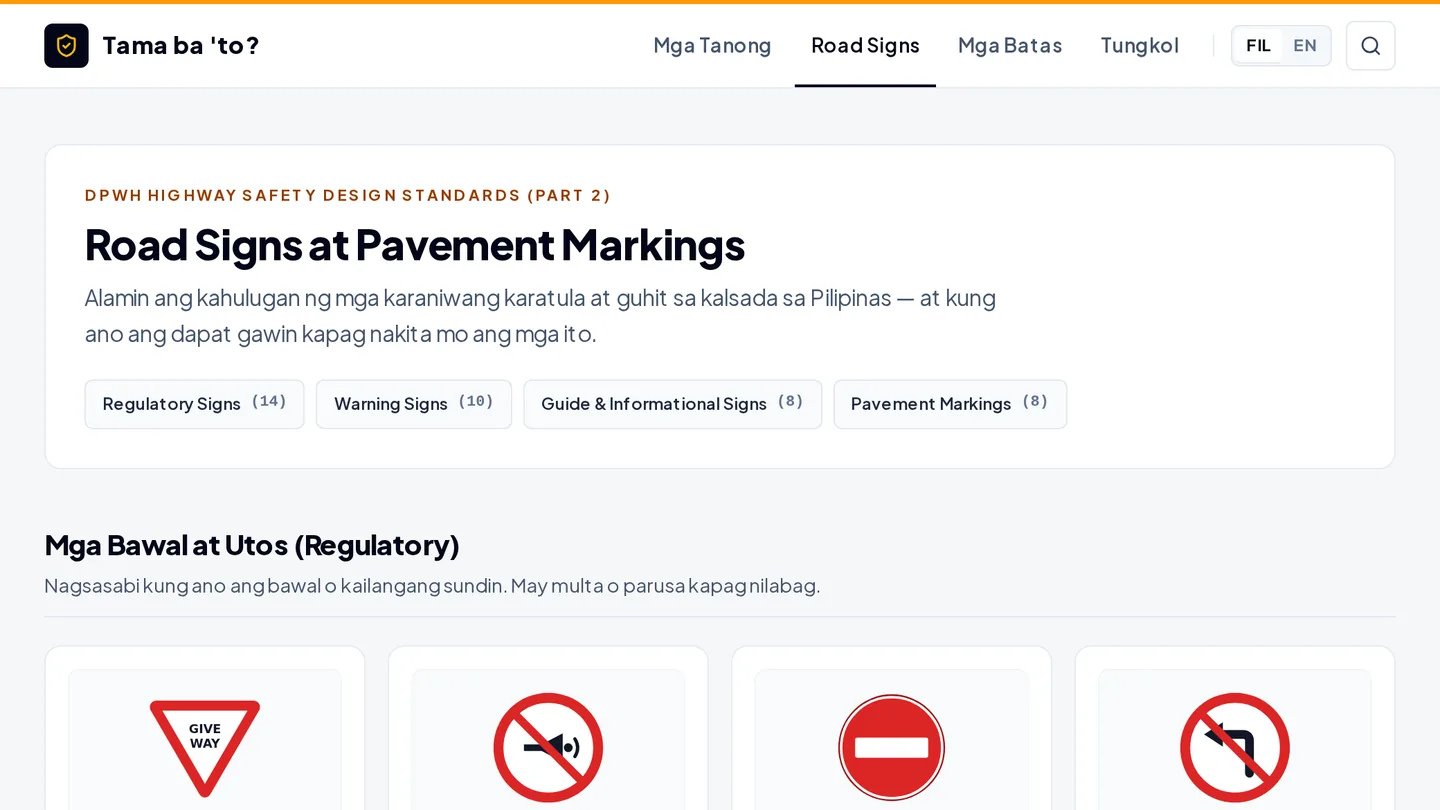
- Fully static. Every answer, sign, and law page is pre-rendered (
output: "export"), so pages load fast on slow mobile data and there's no server to maintain. The only service is Netlify Forms for "report a mistake". - Installable, and works offline. A web app manifest with maskable icons lets people add the site to their home screen like an app. A service worker saves the home page, the signs gallery, the laws index, and the search index on the first visit, plus every answer the visitor opens, so those pages and search still work with no signal. Online, pages always come from the network first, so a corrected answer never gets stuck on an old copy. The worker only handles same-site GET requests, so the report form and analytics are never cached.
- Content as JSON files in the repo. Each answer, sign, and law is one file, so every content change is a reviewable diff.
- Road signs drawn as SVG from the DPWH design standards, never copied from scanned manuals.
- Share previews generated at build time. Each page gets its own 1200×630 Open Graph image, rendered with Satori and Resvg.
- Tests and CI. Vitest covers the schemas, Taglish search, a render of every published page, the share fallback, and automated accessibility checks with axe.
What's next
- Hand-checking each fine against its source before wider promotion
- An LTO exam practice mode
- Local ordinances beyond Metro Manila