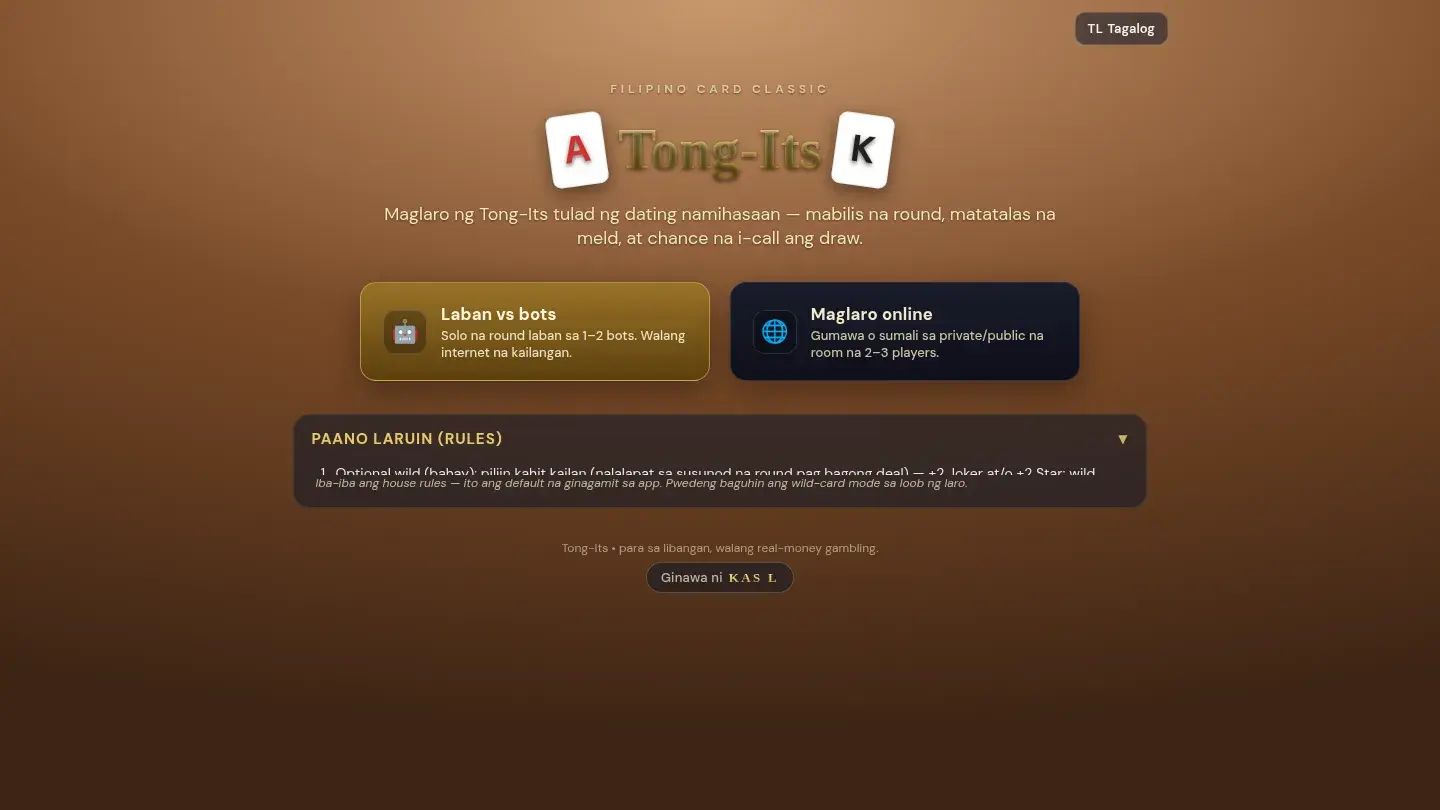
It started as a card tracker I used during real games: mark your hand, mark every discard, and see which cards are still live. It grew into a full game you can play in the browser.
What it does
- Play offline against 1–2 bots. No internet needed once the page loads.
- Play online. Create or join a private or public room for 2–3 players, with in-room chat.
- House rules built in. Sapaw, draws, and wild-card modes follow common house rules, with a rules screen for anyone who learned it differently.
- English or Tagalog. The whole interface switches language.
How it's built
The rules live in one place: a plain JavaScript game engine. The React frontend uses it for offline games, and the Node.js WebSocket server imports the same file to run online rooms. Because both sides run the same code, an online move can't be valid on one side and invalid on the other.
The engine has Vitest unit tests covering deck sizes, deal counts, the sapaw rule that a player must have opened first, and state versioning so clients ignore stale updates.
Deployment
The frontend is a static Vite build on Netlify. The WebSocket server runs separately on Render, because a static host can't keep sockets open.